My blog has moved!

You should be automatically redirected in 6 seconds. If not, visit
http://www.farwestchina.com
and update your bookmarks.

Friday, March 05, 2010

Pictorial History of Kashgar's Id Kah Mosque (circa 1936)

Today I would like to begin a new photo series entitled "History in Pictures" to accompany the Picture of the Week series.  I was able to get my hands on a some great pictures taken back when explorers were roaming the south of Xinjiang (read my review on a book about these explorers) and I'm excited to share them on a bi-weekly basis.  First up...the Id Kah mosque.

Kashgar's Id Kah Mosque

The Id Kah mosque is one of the oldest and largest in all of China, dating all the way back to 1442.  It was severely damaged during China's Cultural Revolution but purportedly restored multiple times by the local government and declared a protected monument.  The pictures below were taken almost two decades before the CCP came to power and created the Xinjiang Autonomous Region.

This shot was taken in 1936 by an Englishman named Skrine who was traveling with Aurel Stein during his explorations in Xinjiang.  Skrine doesn't credit this as being the Id Kah mosque, however there is no other building in Kashgar even remotely similar in architecture like this.  A closer look reveals that when this shot was taken, the mosque wasn't covered in beautiful yellow tile like it is now and I believe that the film slide is backwards (the minaret should be on the right).


This picture, credited to an E. Techman, is confusing because it also claims to be taken in 1936.  Here you can see that the yellow tiles are present and the minaret is on the correct side.  Like the picture above, it seems as if a trading market is taking place as usual around the mosque.


Today the recognizable yellow tiles stand out against the trees which have grown in the courtyard over the past six decades.  The market next to the right-side minaret has been taken away to add more space for worshipers, which during the Muslim holidays can be quite a few (watch the amazing video of this festival here).  Since 1936 a lot has changed around the mosque and inside, but the face has amazingly stayed the same.


Monday, December 28, 2009

Picture of the Week: Kashgar's Id Kah Mosque

*The following is a scheduled article.  Until noted otherwise, my ability to access the internet has been completely cut off*


Although the face of Kashgar is rapidly changing with the demolition of the Old Town, one part of the city remains proudly standing: the Id Kah Mosque.  This is reportedly the biggest mosque in all of China and during the major Muslim holidays is stuffed with tens of thousands of worshippers who gather to pray (see a video of this event here).


Thursday, December 10, 2009

Picture of the Week: Uyghur Instruments


I took this picture at the Uyghur Musical Instrument Factory in Kashgar. All along every inch of wall space stringed instruments were either hanging or leaning. The most famous of these is the rawap, the instrument you see with what looks like horns coming out of its neck. The owner convinced me to sit down and try to pick out a few songs with him but I ended up spending most of the time just watching him play.

It is possible to buy a souvenir Uyghur instrument for pretty cheap but it’s not quite playable. The nicer ones however, like the ones in this picture, were far too expensive for me to purchase. I’m a guitar player and I’ll probably pick one up someday, but for now I’m content listening to people who play it far better than I ever could.


Thursday, October 29, 2009

Picture of the Week: Woodworking in Kashgar


Father and Son share duties at the woodworking shop

I came across this cool scene on a small street in the Old City of Kashgar. Among the endless stands and stores selling all sorts of Uyghur antique souvenirs a man and his son patiently chipped away at pieces of wood. The young boy, no older than thirteen years old, used a large axe to break apart the logs while his father worked the lathe using a tiny chisel. After chatting with the both of them for a few minutes I ended up buying two simple candle stands that had since been painted and stained. It wasn’t expensive and these aren’t the type of souvenirs that are typical of Xinjiang, but this is the kind of stuff I like to remember a place by.

Sadly, the road where this shop used to stand has been torn down following a government plan to rebuild the Old City section of Kashgar and relocate all of its 220,000 inhabitants to newer housing. I probably won’t ever find out what has become of this father-and-son wood shop, but now I have a couple of candlesticks to help me remember what used to be.


Wednesday, May 20, 2009

Kashgar's Old Town Bulldozed; Is Uyghur Culture in Danger?

Within the narrow alleyways of this Old Town lie thousands of years of Kashgar’s history.  Aged wooden doors and cobblestone paths have witnessed the passage of innumerable donkey carts, small Uyghur children and, in recent times, many foreign tourists.  On the outside, these mud-brick walls seem at peace with their place in history but just beyond the padlocked door a crippling truth emerges.

 The remains of an Old Town block courtesy of Abandon the Cube
 
Squinting through the cracks in the doorway it is possible to see that these walls no longer house Uyghur inhabitants.  Instead, they hide the heartbreaking destruction of Kashgar’s Old City.  Over two-thirds of the city has already been leveled.  History has been replaced by rubble; donkey carts by bulldozers.

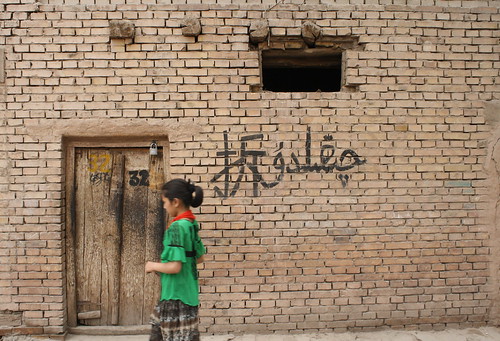
Like a prisoner waiting for its execution, many walls still stand with the simple Chinese character 拆 ("chai") meaning “destruction”.   Some of these condemned city blocks will reportedly be turned into a tourist center to keep the cultural heritage alive, but nothing will be able to replace what has been lost this month.

It is very easy to let emotions to control the debate about China’s decision to demolish the Old Town of Kashgar.  The Chinese have an uncanny way of making a mess of their minorities. In order to fully understand what has happened here, however, both sides of the story must be presented.

Chinese: Transformation through Investment

China has spent a total of $448 million dollars as part of its plan to relocate over 220,000 Uyghur residents from the unsafe homes in the Old Town community to a newly built apartment complex.  According to city planners, the area has suffered from overcrowding, poor drainage, dangerous fire hazards, and susceptibility to earthquakes.  There is no doubt that these homes would break every fire, safety, and building code in any western country and it is in the best interest of city officials to protect its citizens.
A view of the Uyghur's new 6-story "China" homes

Compensation has been offered for those whose homes have been destroyed and the new apartments, besides meeting city standards, are a drastic improvement over the shoddy Old Town homes.

The average Han Chinese citizen doesn’t understand the international ruckus that this government investment in Kashgar has caused.  Not only is the government providing new housing for the Uyghurs but they are protecting them from potential problems which they cannot afford to fix themselves.  Part of the Old City will still be preserved and a tourist center has been planned for the area.  The world seems to be heaping criticism on a project that they believe might, in the case of a future earthquake near Kashgar, save many lives.

Uyghurs: A Shot to the Heart of Uyghur Culture

The Uyghurs have long felt that the Chinese government is slowly destroying their heritage and culture.  Signs of this destruction are evident in the trend of Xinjiang’s ethnic demographics over the past three decades and continue to be felt in major city projects like this one.  Kashgar, historically the heart of Uyghur culture, tends to suffer the tightest control from Beijing (exemplified by the oversized Mao Statue).

Sure, the government is providing housing and compensation for those who have been displaced, but at what cost?  These buildings have withstood thousands of years of whatever Mother Nature could send their way and yet they still stand.  Many Uyghurs argue that living in the Old Town is safer than the modern Chinese concrete high rises they are being moved to.

Another concern is the lack of employment.  A roof over the head is great, but without a steady income it will be difficult to put food on the table.  Most of the previous employment was interconnected with the Old Town itself, so when it was destroyed so was their livelihood.

My Personal Opinion

While the Washington Post made waves by breaking this story, I think an article by The National did a better job of dissecting the situation.  The circumstances are not a simple black and white, so I believe it is wrong when the Chinese paint this as an act of selfless giving to their minority neighbors.  At the same time, I also believe it would be wrong for the international media to turn this into a conspiracy to completely destroy Uyghur culture.  Saying that the Uyghur culture is built entirely on wood, hay and stubble (or in this case mud) is in itself a mockery of this very beautiful people.

That’s not to imply that the Uyghurs don’t have a right to feel threatened.  It is obvious that they will not be getting much (if any) help in preserving their identity, so it is entirely up to them.  When events like these strip Uyghurs of their power to protect their identity, there is plenty of room for concern.

I am not naïve enough to believe that the motives of certain powers-that-be in China are entirely pure, especially considering its history dealing with minorities, but I do agree with the article by The National that this clash has “more to do with cultural sensitivities than politics”.  China is on a mission to secure this province and all of its oil resources and its most successful method of doing so has been rapid development with large investments.

It’s the same mentality they use with their national monuments (read The Business of History in Beijing).  Think about the Great Wall.  What was it once made of?  Wood, mud, and stones.  Now it has been rebuilt with concrete steps, metal railings, and gondolas.  I still find the crumbling parts of the wall the most beautiful.

The same goes for Kashgar’s Old City.  No matter what renovations and cultural museums take the place of of the mud brick walls, I will always remember the beauty of the ragged and dirty alleyways of old.
----------------------
I would like to extend a special "thanks" to Lauren from the Abandon the Cube blog for her stories and use of a few of the pictures you see above.  Please read about her recent trip to Kashgar or check out more of her pictures on Flickr. Thanks Lauren!


Tuesday, March 17, 2009

Picture of the Week: Uyghur Hat Stand

 
 Kashgar Hat Stand by sakuuzala

When you come to Xinjiang you'll see these hats everywhere, usually worn by the Uyghur half of the population.  Also known as a "dopa" these 4-angled hats - brightly colored and embroidered with beautiful beads - have come to be known by some as a symbol of the Uyghur people.  Here you see a small shop in Kashgar showcasing the variety of sizes and colors of hats you can find to buy as a souvenir.  Stop by and grab one for yourself.

Thanks to Sakura for contacting me to submit some photos.  You can find more photos like this on the "This is Xinjiang" photostream along with another foreigner's view of Xinjiang at the This is Xinjiang! blog.

- - - - - - - - - - - - - - - - - - -
 
If you are interested in contributing a photo to FarWestChina's Picture of the Week series, please contact me and send in your Xinjiang-related photo. All photos must be originals and will be credited to you and/or your personal website.


Wednesday, February 25, 2009

A Visit to Kashgar's "Old City"

There's a good reason why everybody tells you to visit the old portions of a Chinese town. You know, the Beijing hutongs, Pingyao's walled city, or the ruins located near most any north western Chinese city.  Besides the fact that the modern parts of town can be repetitive and boring, the old sections are just so darn cool!  So when I found out during the planning phases of our trip to Kashgar that we'd be able to walk around an old city in the middle of town that is virtually untouched by modern society, I was more than a little intrigued.

There actually seem to be a couple of "Old Towns" within the northern part of Kashgar, some hidden behind large buildings, others jutting out in a proud show of defiance against the encroaching modern society.  You won't find any Chinese influence in the architecture and the only occupants within the walls are of Uyghur descent.  They've been here for over 2000 years and I doubt they plan on moving any time soon.  In my search for a good souvenir to take back from Kashgar I found no better place to buy handmade crafts than with the locals who reside along the Old City roads.
 
That is, if you want to call them "roads".  Plenty of motorcycles, bicycles and wagons slowly meandered along the paths as we walked, but noticeably absent was the sound of many cars and car horns.  Most of the time we were walking on dirt but occasionally the more heavily used areas were laid with bricks, stone or tiles.  Any time we went inside someone's house we had to take our shoes off, and it's no wonder since any rain, scare though it is, would make for quite the muddy shoe.

I looked closely at the walls and can't believe they they've stood for so long.  It seems like a combination of hay, mud, clay and maybe some spit thrown in for good measure.  From the looks of it I could run straight through these walls leaving a cartoon-esque imprint of myself, but a solid hit with the fist told me I'd probably just end up with a broken nose if I tried. The doors to these homes are absolutely beautiful, though - usually two hinged doors crafted out of wood with intricate designs and decorated with brass knobs or handles (see picture below).  According to someone we talked with in the city, a locked door means nobody is home or a woman is home alone, one open door signifies family is present and two open doors tells the world you have guests.

The travel books we read told us to enter by certain gates, gates which are guarded by people with fancy looking booths, maps, and cash registers.  The truth is that you can just walk around the corner and enter wherever you want.  Sure you won't have a personal guide or a map but sometimes you don't need those things in order to enjoy the beauty of an aged city.  One of my favorite memories of Kashgar was walking down those narrow roads, watching the children play and pretending that I was actually experiencing Kashgar life centuries earlier.

It's an often used cliche, but it still applies: Like a fine wine, these old cities just seem to get better as the decades and centuries go by.
 
It looks like it's about to fall down, doesn't it?  Hard as a rock, though.

 
These doors are a beautiful contrast to the brown walls and each is unique in color and design.
 
  
Once inside, these houses are no longer dull.  Alluring courtyards provide a cool gathering place for friends and family.
 
  
Some residents still make a living selling crafts, like these women and their hand-painted jars. 5-30 RMB each for a small one...not bad.
 
 
Kids make great photo subjects no matter what kind of city you're in.
 
Special thanks to Andrea and David for use of some of their pictures taken during our trip to Kashgar.

Update (03/08): Better get around to visiting this place soon!  According to news reports, this Old City is slowly getting torn down and replaced with newer buildings.  Such a shame.


Monday, February 23, 2009

New Kashgar Dress-Code Requires "All-Chinese" Look

I used to work at a summer sports camp years ago named Kanakuk that required strict dress code for its employees, a code which they referred to as the "All-American Look".  Clean shaven, managed hair, no jewelry for men...you get the picture.  Now I know that there are plenty of people who would find that discriminating, however I was aware of their requirements when I sought employment and I was perfectly content complying.  It was just part of the job.

I thought about that camp today while reading the news.  An article on RFA highlights a new point of contention in the always restless (although not necessarily dangerous) region of Kashgar.  Here are the hairy details (pun...intended):
"Authorities in China’s westernmost city of Kashgar are stepping up pressure on government employees to go clean-shaven, and the city’s large ethnic Uyghur population, whose adult males overwhelmingly sport moustaches, aren’t happy about it, residents say."
In other words, the Kashgar government has instituted a strict "All-Chinese Look" in an area where minorities are actually the majority.  Not everybody has to shave, mind you, just the state employees.  It might be good to note that Chinese are notorious for being unable to grow good facial hair. 

I admit I'm having to take some time to think about this one!  It seems unfair and discriminatory, yet I didn't blink an eye when it was happening in America.  What's the difference and do these people have a right to complain?


Here's my quick take on it all: there are quite a few people who wouldn't want to be subjected to the dress code enforced by the camp I worked at, but I would venture to guess that most of those people aren't the types that should be working there anyway.  It sounds unfair, but some people have to go to work in a tie and suit or they get fired.  As long as these requirements are outlined and agreed upon beforehand, what's the difference?

Along that same train of thought, I have no problem with a city government asking for a specific dress code to be upheld - as long as it is outlined and agreed upon by all parties beforehand.  I can't make a judgment on whether or not that is the case here, as the person interviewed in the RFA article has a distinctly Uyghur name ("Tohti"), but I do have my doubts.  Controls have obviously been put in place in this area for a while now, and while this could be another one, it could just as easily be a government that wants its employees to look clean shaven.

What do you think?  Is this a fair or unfair requirement?

Source:
  RFA: Kashgar Uyghurs Pressured to Shave

Tuesday, January 06, 2009

Picture of the Week: Kashgar's Old City

 
A humble home in the heart of Kashgar's Old City.
 
- - - - - - - - - - - - - - - - - - -
 
If you are interested in contributing a photo to FarWestChina's Picture of the Week series, please contact me and send in your Xinjiang-related photo. All photos must be originals and will be credited to you and/or your personal website.


Saturday, November 22, 2008

The Kyrgyz Mother from Karakul Lake

The sun patiently rises as it does every morning, painting the sky with varying shades of blue while creating dark silhouettes of the Pamir Mountains reflected on Karakul Lake below.  At the base of the Muztagh Ata, the largest of these Pamir, a small village is already awake and far too accustomed to these dramatic natural scenes to take any special notice today.  Officially this land upon which this breathtaking scene has unfolded belongs to China, a portion on the western tip of Xinjiang, but you'd never know by looking around. Every one of the less than 200 inhabitants of this village claim heritage from Kyrgyzstan, one of the countries on the other side of these tall peaks, and most of them will be herding cattle today just as their ancestors did centuries ago.

Among these people is a young Kyrgyz woman named Cholpon who was born and raised not even five kilometers from this lake.  At the tender age of 25 she has already given birth to three children, the oldest being seven years old, all of whom currently live with their grandmother in a nearby village while Cholpon works hard with her husband to help sustain the family.  Her sharp, blue eyes are the only evidence of youth hidden behind layers of leathery skin, tanned and slightly wrinkled from years of outdoor physical labor.  Her clothes are well-worn and old yet warm enough to endure the cold will soon come over this area during winter.

I watch intently from a distance as she non-chalantly fetches a heavy bucket of fresh water from Karakul Lake in order to make breakfast.  MY breakfast, that is.  It's hard to believe, but I just woke up from a night spent sleeping at the foot of a beautiful mountain in a yurt, a tradiational dwelling not quite as permanent as a home but much more sturdy than a tent.  Made entirely by hand, this yurt took all of three hours for Cholpon's husband to set up and features wool coverings, a lockable wooden door, and a cooking stove fueled by wood and cattle patties.  When completely disassembled this home can be carried by a single donkey or horse, the perfect solution for this once nomadic people.
 

Instead of roaming the countryside like their ancestors, though, these Kyrgyz people now earn part of their living by hosting adventurous foreigners like me and my wife.  During our stay here they have provided us with warm housing and good company topped off by a traditional meal cooked by Cholpon herself.  Breakfast this morning before we leave is just icing on the cake.  Upon entering the comfortably warm yurt I find that she has almost finished preparing our morning snack and my wife has completed her morning routine.  Cholpon has been too shy to look at us much since our arrival and the fact that she doesn't speak English or Mandarin has made communication difficult, but there is a beauty in her eyes and face that draws us to her.  She seems thrilled when we ask her to sit down and eat breakfast with us.  For ten short minutes we converse using the universal language of hand motions, mostly talking about her children, permitting us our only glimpse of her smile as she excitedly shows us a picture.
 
As quickly as the smile came, it vanishes, and she nervously leaves us to finish her chores the moment she hears the footsteps marking the arrival of her husband.  He's a calm man, not abusive by any means, but I'm now learning that this male dominated-culture frowns upon her socializing with other males like me, especially when we're foreigners.  He has been very good to us, taking us on a horseback ride to his village, sharing with us a brief history of the area, and answering all our questions, but interestingly he has made no effort to include his wife in our interactions.

We pack our pack our bags to put in the trunk, but before we leave, our friendly host has one more thing to show us - a small wool carpet hand-woven by his wife.  Cholpon proudly displays her work to us and it's all we can do to keep from buying each piece.  We've spent only 10 meaningful minutes with this woman and yet we desire something to remember her by, a small token of her life's work to be appreciated for years to come.  As we shut the car doors to return to Kashgar, I am able to meet eyes with her one last time knowing that once we drive away we will never see her again, yet she will still continue to work and serve and miss her children.  Oddly, I can see no trace of unhappiness or regret in her eyes.  She works hard and loves her family just like many other mothers do, and she is proud to do so even if it is in a very small village on the edge of Xinjiang. This is her life - the only life she has ever known - and she is content.


Friday, October 10, 2008

Kashgar, Eid, and the Id Kah Mosque

It's always overwhelming to find yourself surrounded by more than 30,000 people at any point in time...whether at a sporting event, concert, or celebration...but it boggles the mind when such a gathering is performed peacefully, quietly, and quickly.  So it was on this quiet morning of Eid ul-Fitr that we woke up extra early to experience what happens when Muslims from all over Xinjiang converge on a single location to celebrate the end of Ramadan.

Id Kah Mosque

Located in the heart of Kashgar, a city on the westernmost tip of China and populated primarily by Chinese Muslims, is the largest and, according to many, most beautiful mosques in China.  I refer to the Id Kah Mosque as the "8 Car" mosque because when I asked a local say the name, I could have sworn it sounded exactly like he was telling me to go find eight cars somewhere.  For Muslims in this area this place is a holy site - many travel for days to worship here during the big festivals.  For those who have travelled around much of the world, however, its really quite small and somewhat unimpressive.  The building, that is.

The day before Eid we decided to take a look around the mosque to find out what all the buzz was about.  At the cost of a whopping 30 RMB per person (approx. $4) we spent an entire fifteen minutes wandering around a large, open-air courtyard towards a prayer hall that housed nothing but carpets to kneel on and columns to keep the roof from caving in.  We weren't impressed.  We shouldn't have expected much more, I guess, but our understanding of the Muslim culture was practically nil so it was hard not to be disappointed after paying to see it all.  If I had known then how many people were going to be cramming into every available floor space in this enclosed area, I might have viewed things a bit differently.

Ramadan and Eid ul-Fitr

For those unaware, Eid ul-Fitr marks the end of the month-long religious fasting called "Ramadan".  For the entire month a fast is supposed to be observed from sun-up to sun-down until the final day when they hold a celebration that seems to me to be as big in their culture as Christmas is in America.  People travel long distances to see family, visit friends, and in many cases to visit an important mosque.

So when we woke up that morning after Ramadan, we knew there would be a lot of people, but that still didn't adequately prepare us for what we saw.  We arrived at 8am to find people from every direction of the city converging on the small yellow mosque which seemed to swallow thousands of them every second.  The only sound we heard were soft footsteps and one small boy trying to sell carpets to those who only brought plastic bags to kneel on.  For one full hour the masses never stopped coming and the mosque never stopped swallowing.  I later found out that the mosque can hold up to 25,000 people at once, but I figure there's got to be some huge fire code violation going on there.

The Gathering and Prayer

Have you ever witnessed this many people performing the same actions and saying the same things all at once?  It's eerie!  Even though I share very little of their beliefs - or perhaps for that very reason - it sent chills down my spine.  They were of course all facing Mecca, one part of this ritual I was already aware of, and the words and prayers being spoken were echoed everywhere and completely incomprehensible to me.  The entire ritual lasted less than 20 minutes, a portion of which you can see in the video below.  Once finished, everybody left in the same manner as they arrived: peacefully, quietly, and quickly.  It's something I'll never forget, and if you ever find yourself near a major mosque during Corban or Eid, the two largest Muslim festivals, get yourself out of bed early and go watch.

If you have seen this in person, what did you think?


Tuesday, October 07, 2008

Welcome to Kashgar: Heart of the Silk Road

On the westernmost tip of China lies a city that is caught up in an inward struggle over its identity. Is it part of the second largest desert in the world or located at the foot of the Tian Shan mountain range?  Is it on the far west tip of China or right in the middle of the Silk Road?  Is it Uyghur or Han Chinese?  Is it an old city characterized by its thatched houses and donkey carts or a new city sprawling with new high-rises and buzzing with taxis?  Kashgar, it seems, is all of these things.

In terms of size, Kashgar is relatively small, boasting close to only 400,000 inhabitants, yet it is well known all over the world as the cultural and commercial capital of the Silk Road.  Recent events have unfortunately given it the reputation of being a hotbed for conflict and terrorism, but frankly I felt more safe walking with my wife around the streets of this city than I do in Urumqi, Xinjiang's capital. We had a great time getting lost in the labyrinth of walkways that crisscross the old town, meeting people who weren't trying to sell us their goods while experiencing what it much have been like to grow up in this town a century earlier.

Touring the city, though, it's hard not to notice the internal conflict that is slowly changing, though not destroying, the face of this city.  Not even a mile from Id Kah, the biggest Muslim mosque in China, stands one of the largest statues of Mao ever erected. The placement wasn't accidental, and that hasn't gone unnoticed by the locals.  The main road through Kashgar not only divides the town physically, but also serves as a barrier between where the Uyghur people live and where the Han Chinese reside.  The tension isn't visible or even near the surface as far as I can see, but I'm sure it's there.

Thankfully there are more reasons to visit Kashgar than for political or social observations.  Its awkward location between mountains and desert provide breath-taking scenery on many sides of the geographical spectrum and its generally calm weather give you ample opportunity to soak it all in. The people we met on our journey who helped us, drove us, translated for us, and even took us out to eat are a reminder that stereotypes, even the old "tourist trap" stereotype, sometimes only serve to make us afraid of what we don't know or understand.

We traveled to Kashgar and surrounding villages; we experienced the Uyghur, Kyrgyz, and Muslim cultures; and thankfully I can say that we'll never look at them the same way again.


Monday, October 06, 2008

Danger Travelling in Kashgar?

"I definitely do not want you go to there.  It's not safe, especially this year.  Haven't you heard what has happened there recently?  I think it is best if you stay here or go somewhere else for the October Holiday.  It is not wise for you to travel to Kashgar right now."

These are the words of our school principal three days before we left on our trip to Kashgar, a place most recently known for violent attacks and unrest.  Understandably he was worried, and we were flattered by  how much he actually cared.  Were it not for the fact that we had already bought our airline tickets and our friends from Shanghai were already headed there, we might have reconsidered.  Instead, we were in the uncomfortable position of going against our boss' wishes, somewhat hiding a few of these "controversial" details from our families, while wondering if we really were in that much danger.

As it turns out, the danger was very little and the experience was one of the greatest we've had since arriving here in Xinjiang.  On the way back to Urumqi from Kashgar we took the 24-hour sleeper bus to save some money which gave me time to write down a few things that had been festering in my mind:
  1. This trip highlighted for me how much Chinese don't trust the Uyghurs and vice-a-versa...and neither group can really give me a good reason why.
  2. The more I observe each group of people in Xinjiang, the most diverse part of China, the more I see the similarities between them as opposed to just the differences.
  3. As I travel through China, I am convinced with every trip that Xinjiang is by far the most visually captivating, culturally pleasing, diverse part of China.  
Over the next couple of weeks I want to go a little more in-depth on some of these issues while sharing with you stories and pictures of our journeys around Kashgar, the westernmost part of China and a truly unique part of the Silk Road.  I hope you enjoy.


Blog Widget by LinkWithin