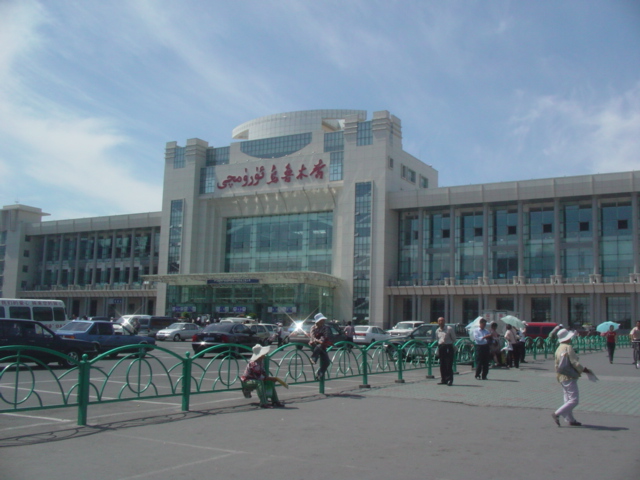
Getting your hands on good train tickets in any major Chinese city during the Spring Festival is without a doubt one of the most difficult tasks known to man. Right now tickets halls from Beijing to Shanghai to Xi'an are packed with people who wait countless hours in line for the chance to buy tickets to be with their families back home, an ordered chaos that is led primarily by a fearless group of people known as migrant workers.
But what happens to those migrants workers who have moved to small cities in Xinjiang that don't have train stations? Since train tickets are not yet available for purchase on the internet or by phone, how exactly are they to get a hold of these invaluable tickets to freedom?
My home here in Xinjiang is one of those small cities filled with many of those fearless people and my wife and I just spent the last 48 hours finding out exactly how they get tickets. It's not easy, it's not fun, and unless you are a migrant worker with no other option you should try to avoid it at all cost! If you must, however, here is a brief migrant's guide to help you understand this crazy procedure.
Phase 1: Ticket Office Reconnaissance
Many moderate sized cities in China that aren't serviced by trains will usually have a train ticket office. Two days ago my wife and I scouted out the location in our city - two separate and nondescript buildings near the local supermarket - while trying to figure out which train we needed and the process in which to purchase the tickets. After questioning many different people near the office we began to faintly understand how the ticket system here works.
I think it goes something like this, at least here in Xinjiang: because there are so many people from all over the province who are desperate to get tickets home, a rationing system has been put in place whereby each local train office is allocated only a portion of a train's tickets a maximum of 10 days in advance. Once those tickets are sold, which can take anywhere between 15-45 minutes, that's it for the day. People in Xinjiang are only able to physically purchase train tickets for trains departing from Urumqi, the capital city, and it's all on a first-come-first-serve basis.
Phase 2: Take a Number!!
Unfortunately this "first-come first-serve" business is a two-day process for most people, "most people" including us. Part one begins on the first day at office location #1, a plain, medium-sized hall with two doors, 200 chairs and a single TV. You don't come here to buy tickets today. Instead you come to get a number giving you the right to stand in line the next day to buy a ticket. People start to form a Chinese line outside the office (in other words, a big mass of people) at around 4a.m. in hopes of being given a number when they are handed out every day at 3:30p.m. If you're counting, that's nearly 12 hours of waiting so far (in Xinjiang's frigid winter, no less) and you don't even have a real train ticket to show for it.

My first thought was,
"How can people afford the time to wait that long!" I then remember that many of these migrant workers are seasonal, such as the
cotton pickers, and therefore have lots of time on their hands at the moment. There are also many entrepreneurial types who will wait in line on behalf of somebody else for a fee. We thankfully avoided both these options because we unknowingly garnered the sympathy of the one of the office workers who, when we arrived early that morning told us to just come back at 3:30 and he would save us a number. Were it not for that man's sympathy we would not have tickets today.
Phase 3: Train Nazis and Train Tickets

This morning we woke up at 6a.m. in order to get in line to purchase our tickets at train office #2. I actually went alone because each number can only be represented by a single person and that single person can only buy three tickets. My first stop was office #1 where I witnessed something that very few people get to see in China - an actual line.
This line of people with "numbers" was made possible by a man I decided to nickname the "Train Nazi". Loudspeaker in hand, I was convinced Mr. Train Nazi was ex-military as he barked orders and literally shoved people who didn't have tickets out the door. I felt like a lucky kid with a golden ticket to Charlie's Chocolate Factory, except I wasn't excited - I was nervous. What if they didn't have any train tickets for where I wanted to go? Nothing was guaranteed and all of this would have been wasted time and effort.
For an hour I waited in line at building #1 as people who were taking part in today's Phase 2 were allowed to fill the room to wait for the next 3:30 ticket distribution. The entire time many people who didn't have numbers were badgering all of us in line to find out if we were using all three of our allotted ticket purchases. If we weren't they would beg and bribe us fortunate souls with numbers to purchase a ticket for them and were prepared to hand over money, ID cards, and a piece of paper stating the ticket desired. Although I personally didn't offer the services of my third unused ticket allocation, I witnessed a few people who did and I'm sure they made a small profit from it.

At this point, still a few hours before sunrise, we were led in a single-file line over to office #2 where we had to hand over our numbers before we would be allowed entrance by the guard at the door, another Train Nazi with an ex-military style attitude. For the first time in this entire process while looking at two ticket counters in front of me I felt like I was actually buying a train ticket. The place wasn't as packed as office #1 but it was still chaotic with guards shouting orders and people venting frustration after finding their train was already sold out. My nerves would not be settled until I had two tickets in my hand.
These Tickets are GOLD!!
Thankfully our train hadn't yet been fully booked, so for the first time in three years of trying to take a train on Spring Festival we have successfully purchased tickets. As interesting as it was, we won't be doing it again and from the stories we've heard might even regret this trip because of how crowded the train will be. No matter. We saved a ton of money and the experience has not only given us a new appreciation for the life of migrant workers but also an insight into the value of Spring Festival train tickets.
According to my basic-level understanding of supply and demand -
these tickets are GOLD!